Trump's 25% Car Tariffs Push Prices Up $4,000-$6,000 — Supreme Court Rules Tariffs Unconstitutional, $20B Refunds Coming
The Supreme Court ruled President Trump's global auto tariffs unconstitutional in early 2026, and the government will start refunding $20 billion to automakers and suppliers starting April 20. But there's a problem: automakers already raised prices to cover the tariffs, and those prices aren't coming back down. American car buyers are stuck paying thousands more for vehicles whether the tariffs are legal or not.
Read Also: Meet the 84-Year-Old Honda Engineer Behind Your Car's Safety Tech — And His Viral Anime Hair
The Supreme Court struck down tariffs imposed under the International Emergency Economic Powers Act (IEEPA), determining the president overstepped his authority. Over 300,000 companies paid these tariffs and are now eligible for refunds. The process will be complex and lengthy, with some cases potentially taking years to resolve.
But Trump's 25% tariffs on imported vehicles and auto parts remain in effect under Section 232 authority, which cites national security concerns. An August 2025 deal with the European Union temporarily lowered those tariffs to 15%, but Trump recently threatened to raise them back to 25%, specifically targeting German automakers like BMW, Mercedes, and Volkswagen.
What This Costs Car Buyers
The tariff impact shows up immediately in vehicle prices. Analysts estimate an average $2,000 increase on US-made SUVs that use imported parts, and $4,000 to $6,000 on fully imported vehicles. A Hyundai Venue that cost $24,000 now runs about $28,500 — an extra $4,500 for a subcompact crossover that's supposed to be affordable.
Not sure which car to choose? Take our quiz and find out!
Luxury brands aren't absorbing the costs either. Ferrari announced a 10% price increase on certain models including the 296, SF90, and Roma effective April 1. Audi raised 2026 model prices by $1,900 for the A3 family and $4,100 for the RS 7, though the company is including pre-paid maintenance to soften the blow.
Patrick Anderson, CEO of Anderson Economic Group, explained the reality bluntly:
"There is no way for $10 billion to absorbed by the automakers and suppliers alone. Consumers and workers are going to bear some of these costs."
The Insurance Hit
Car insurance premiums are climbing alongside vehicle prices because tariffs make repairs more expensive. Auto parts cost more, which means fixing your car after an accident costs more, which means insurance companies charge more to cover those repairs.
Industry analysts project average insurance premiums could reach $2,759 in 2026, a 19% jump from fourth quarter 2024. This comes after car insurance already increased 11% in February compared to a year earlier, making it one of the fastest-rising components in the Consumer Price Index.
Who Gets Hit Hardest
Not all automakers face equal impact. Ford sits in the best position, with 80% of its vehicles manufactured in the United States. Models like the F-150 lineup avoid the 25% vehicle tariff, though imported parts used in US assembly still get taxed.
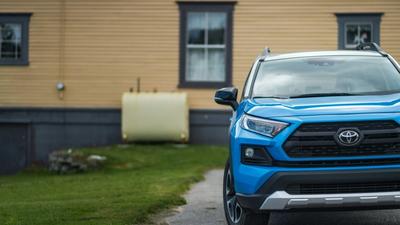
Japanese automakers Toyota and Honda export large numbers of vehicles and parts from Japan to the US market. Both companies face significant cost increases. Toyota explicitly warned that 84.3% of RAV4s sold in America are imported from Canada and Japan, making the 25% tariff unsustainable long-term.
European luxury brands face pressure from multiple directions. Volvo announced it's cutting 3,000 jobs globally and withdrew its financial guidance for 2025-2026, citing tariff pressures as a major factor.
CEO Håkan Samuelsson said, "The automotive industry is in the middle of a challenging period. To address this, we must improve our cash flow generation and structurally lower our costs."
The Political Fallout
American consumers aren't happy. A Harris Poll in March found 72% of Americans said tariffs had a negative impact on their lives. A Pew Research Center poll in April showed 63% of Americans lack confidence in Trump's handling of tariff policy.
The Tax Foundation calculated Trump's tariffs cost US families an average of $1,000 per household. After the Supreme Court ruling changed some tariff structures, that's expected to drop to $700 per household for 2026 — still a significant expense.
Trump reportedly warned CEOs of the Big Three automakers not to raise car prices because of tariffs, according to the Wall Street Journal. But that warning holds little weight when manufacturers face billions in additional costs and shareholders demand profits.
Investment Freezes
The confusion over which tariffs apply, which might be struck down, and what trade deals actually exist is preventing companies from making long-term investments in US manufacturing.

Lynn Calder, CEO of British SUV maker Ineos, said uncertainty about tariffs prevented her from approving the company's first-ever US plant: "We have to make decisions that play out years, and sometimes decades into the future. And that's hard to do" when trade policies constantly change.
RJ Scaringe, Rivian's CEO, echoed the concern: "There are a lot of things we can't predict."
Key decisions that could impact US investments and jobs are being put on hold while companies wait to see what trade policy looks like next month, let alone next year.
What Happens Next
Jonathan Smoke, Cox Automotive's chief economist, summed up the market impact: "Prices will rise and volumes will decline." Higher vehicle costs mean fewer people can afford to buy, which means lower sales.
Stephanie Brinley, principal auto analyst with S&P Global Mobility, noted that consumers won't see a clear tariff line item on vehicle window stickers. "You won't see a line item for tariffs," she explained. But prices are rising across the board, and tariffs are a major driver.
The $20 billion in refunds sounds like good news, but it won't reach consumers. Companies will recoup tariff costs they already paid, but those savings won't translate to lower vehicle prices. The market has already adjusted to higher price levels, and automakers have no incentive to reduce sticker prices when demand remains relatively strong.
For American car buyers, the message is clear: expect to pay more, whether tariffs are legal or not.